
Skin Health: New Biocultural Zones of Contact
This project will advance a more nuanced understanding of skin health and care focusing on the crucial relations between scientific, commercial and everyday skin practices. The project will develop empirically sensitive knowledge and new theoretical vocabularies about current skin health practices.
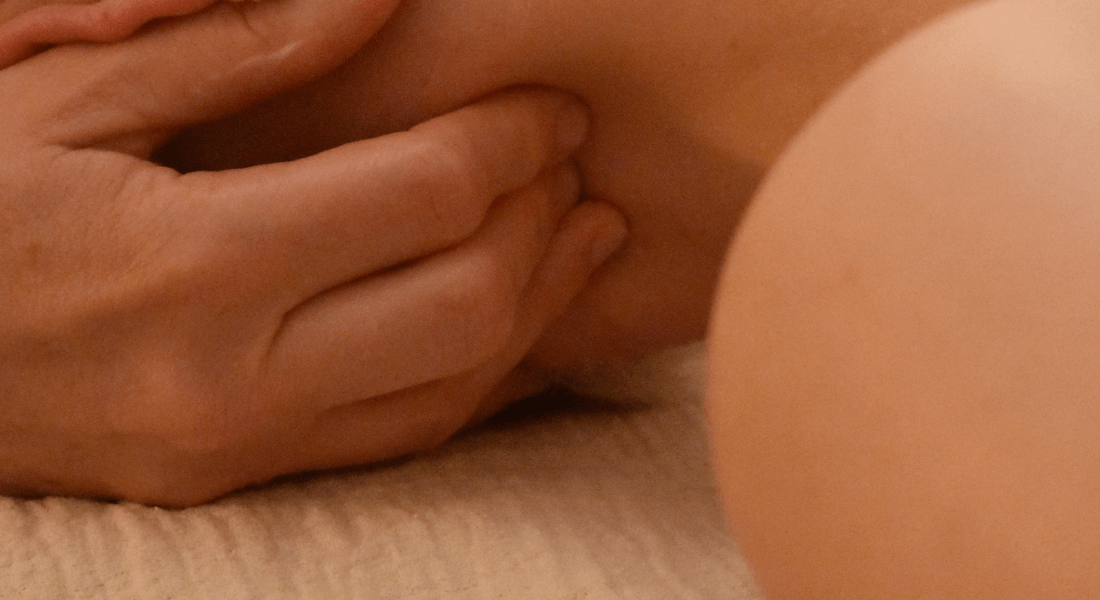
Our skin is our largest organ, and a vital part of our cultural, social, and political fabric. It is highly contested, evoking powerful categories such as gender, age, race and social class. It is our surface and zone of contact. Damaged or ill skin can produce social stigma and personal trauma and activate mechanisms of exclusion. In this project, we will advance a humanistic understanding of skin health and skin care focusing on crucial relations between scientific, commercial and everyday skin practices, thus enabling rethinking of skin health. Investigating these practices through ethnographic fieldwork, we will explore prevailing discourses, medical, technological and everyday practices that define our cultural understanding and engagement with skin health.
The overall research question is: How is current skin health practiced in the intersections between everyday life, medical knowledge, industrial interests and aesthetic norms? To answer the research question, we will work with the following objectives:
- To produce a nested set of ethnographic case studies spanning medical and technological knowledge practices, commercialization, everyday care practices and patient experiences, and situate this in relation to the cultural and medical history of skin and dermatology.
- To empirically and theoretically advance and develop the notion of skin as a complex in-between biocultural phenomenon as an entry to understand current skin related healthcare issues such as inequality, shame, stigma, and medicalized bodies.
- To develop a humanistic methodological concept, inspired by the concept of zone of contact, where ethnographic and cultural historical methods are combined to fully comprehend how historical, cultural, and social aspects are formative for and deeply embedded in current health and care practices, technology development and medical phenomena
Situating disgust: negotiating contamination in an impure world
Situating disgust: negotiating contamination in an impure world was a workshop hosted by the Centre for Sustainable Futures – CSF and the Copenhagen Centre for Health Research in the Humanities – CoRe on 12 May, 2025.
The idea of the workshop was to invite speakers and participants to reflect on processes and practices of purification and its converse, contamination, as well as affects and practices of disgust, from a range of different empirical and disciplinary perspectives. Through ‘situating disgust,’ it aimed to critically engage contemporary and historical modes of differentiation as well as efforts to play across social and material orderings.
Speakers presented a range of topics: Tiff Mak (Medicinsk Museion) talked about disgust and fermentation, Katy Overstreet (UCPH) discussed milk, manure, and the politics of disgust. The Skin Health project members Louise Folker and Miriam Pedersen presented too, the first on Dental Care and nursing homes and the latter on historical treatment of venereal and skin diseases. The workshop was organised around the work of Matthew Wolf-Meyer (RPI – NY), who gave a keynote on fecal microbial transplants, racialized bodies and disgust.
Bloom Festival 2025
Soaked in rain – but happy!
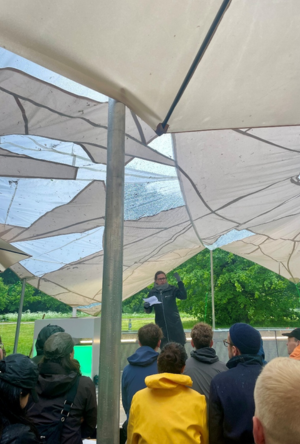 Astrid Pernille Jespersen took part in Bloom Festival 2025 in pouring all-day rain. Even so, the benches in front of the small stage, the Sprout Stage, were completely full. This year’s theme there was research on the senses. We can’t help but feel delighted that so many people braved the rain to hear about the latest research on our sensory system.
Astrid’s talk focused on the sense of touch. According to the American paleobiologist and anthropologist Nina G. Jablonski, this sense is often called “the mother of senses,” because it has been crucial for the survival and social life of primates for millions of years. Nevertheless, the sense of touch often receives less attention than our other senses, even though it plays a central role in human well-being, relationships, and the feeling of closeness.
From this starting point, Astrid presented the research project “Healthy Skin: Cultural-Theoretical Explorations of the Human Visible Organ,” which examines the skin as the human body’s largest and most visible organ — and as a key zone of contact between people. She illustrated how the project works with the skin as a biosocial phenomenon, where the biological properties of the skin are closely intertwined with culture, relationships, and society.
At the end of her talk, Astrid revealed that the podcast “Med huden på arbejde” (“Skin Work”) was on its way.
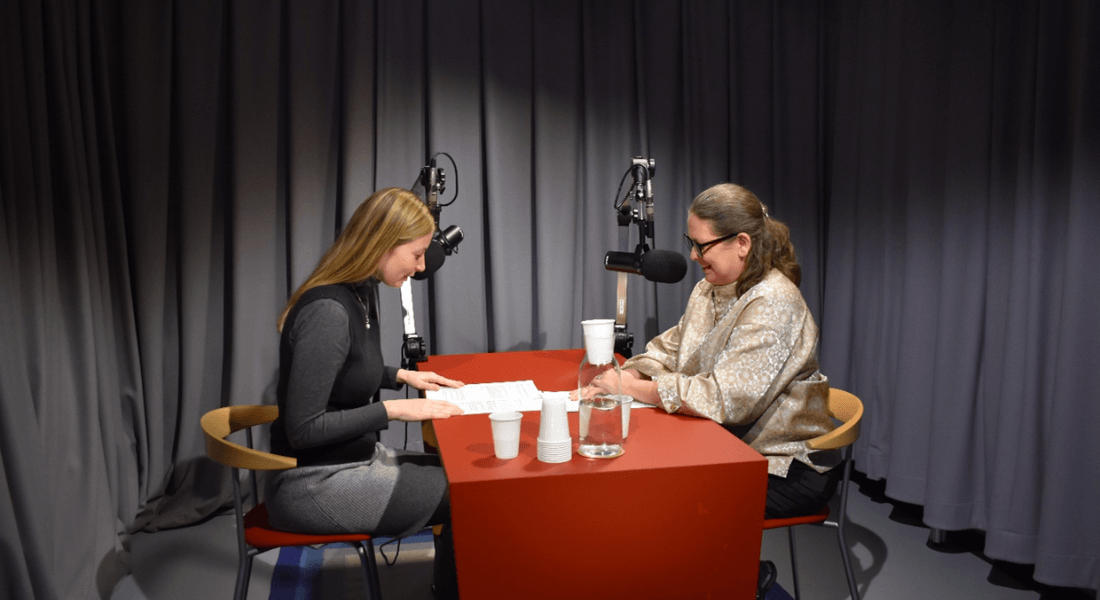
Podcast: Skin Work
Some people touch other people’s skin every day as part of their work. In this podcast, we focus on how they work with, through, and on the skin — as a material, as a sensory surface, and as an object of care and attention.
Skin is the human body’s most immediate point of contact with the world. So, what happens in professional settings when we touch skin?
That is what we explore in this podcast, produced as part of the research supported by the Carlsberg Foundation.
Host: Miriam Leander Petersen
Music: Teis Zacho
Listen to our podcast in your preferred podcast app.
You can follow the research project and stay updated on new activities, publications, and events on LinkedIn by following the Center for Humanistic Health Research (CoRe).
Funding

The project is funded by Carlsberg Foundation, Semper Ardens Advance.
Project period: 1 September 2025 - 31 August 2029
Sub-projects
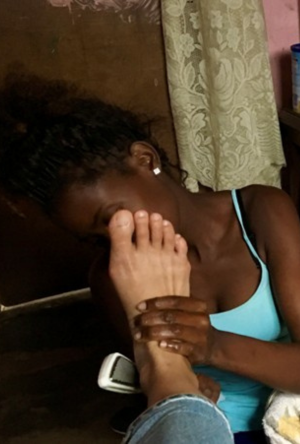 In WP1, Transcending and Translating Skin, we will investigate how scientific understandings of skin construct the way we think and practice skin. Inspired by the current debate and activism on ‘decolonizing dermatology’ we will investigate the medical history of dermatology, where categories such as gender, race, class and morality have shaped not only the medical but also popular understandings of skin. We will study the intensified scientific interest in artificial skin (robotics and skin grown in laboratories) and skin microbiome habitats (the skin as a living landscape). We will conduct fieldwork in cutting-edge research contexts, such as the LEO Foundation Skin Immunology Research Center at the University of Copenhagen, the division of Engineering and Applied Science in Caltech, California, and companies, such as Touchlab in Edinburg, developing and producing eSkin and the US-based AOBiome Therapeutics engaged in developing new medical treatments and cosmetic products.
Flora’s ethnographic study
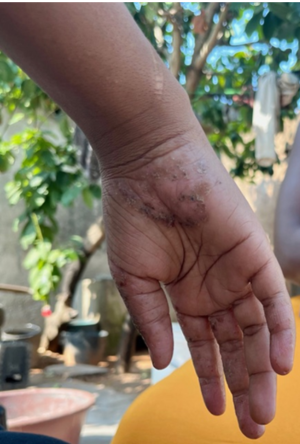 Flora’s subproject is entitled Postcolonial skin: a biocultural nexus of global hierarchies. She sets out to delineate the internal and international relations that have formed and reformed local knowledge about and practices of skin health and beauty in Mozambique, from the late period of Portuguese rule to today. It relies primarily on ethnographic material Maputo, where she has looked at people’s daily skin practices, accompanied skin conditions developments and mapped out health care across private, public alternative spheres. This is supplemented by historical material and studies from colonial and postcolonial periods. The aim is to understand the ways in which medical and cosmetic skin care practices and understandings in present-day Mozambique emerge out of, and interact with, international medical knowledge, and how these frictions reproduce, transform or contest established social hierarchies. The study engages in comparison and further inquiry within the Skin Health project, broadening the scope of what is understood by the decolonisation of dermatology and medicine. Together they provide new points of reference for wider debates about medicinal production and approaches to the skin, which can benefit medical practices.
Miriam’s historical archival studies
Miriam works with cultural and historical perspectives on gender, the body, and health, and she is responsible for investigating the cultural history of dermatology.
Materials from the Copenhagen City Archives relating to Balder's Hospital from the period 1947–1961 form the basis of an upcoming co-authored article in the skin project. The article tells stories about young women’s skin at Balders Hospital and introduces the concept of “patrolling” the skin, elaborating our definition of “patrolling technologies.”
In WP2, Skin and the Life Course, we will study how skin health and skin care is part and parcel of our individual and collective lives, and how it is defined, shaped, and negotiated by a variety of actors in the course of an individual’s everyday life.
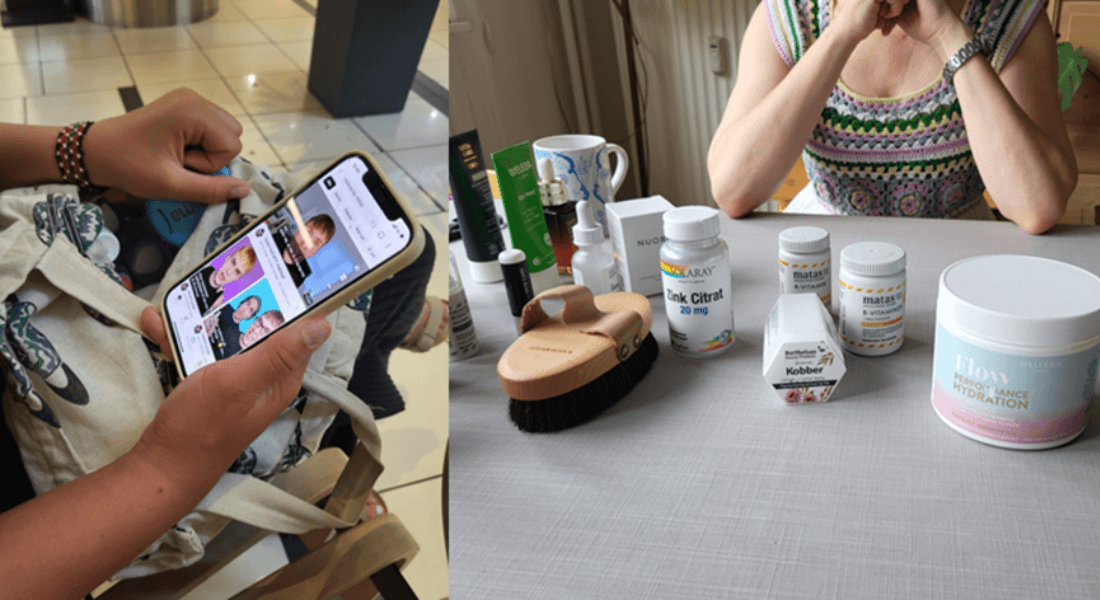
Hélènes part of WP 2, aims to examine how current skin health is practiced at different points in the life course, at the intersections between everyday life, medical knowledge, industrial interests and aesthetic norms. Her ethnographic PhD project aims to contribute to both critical medical humanities and to the emergent field of skin studies, by examining the skincare and skin health practices of very young users, tweens, who consume skincare products originally aimed at the much older anti-age demographic. These young girls are her first case, and adult women in menopause is her second case. Both these cases are chosen as examples of how skincare, and the quest for beautiful skin, has become a central matter of concern in contemporary society and along the life course. Thus, the interlocutors’ skincare practices, examined in this project, are seen as key sites of intervention by various actors, including, but not limited to, the medical industry, cosmetic companies and social media influencers. Hélène’s ethnographic fieldwork consists of interviews and participant observations in families, with youth and menopausal women, as well as with sales personnel and social media influencers.
Nanna’s part of WP 2, starting in autumn 2026, concerns older adults, as another example of another critical skin stage in the life course. Empirically, her research will focus on the daily skin care practices in households and in public institutions, such as in residential care units. Thus, Nanna will pay special attention to the impact of commercialization and aesthetic norms in the daily skin practices of aging adults.
In WP3, The Troubled and Ill Skin, we will develop an understanding of how skin is more than just a passive object of medicalization and treatment, but also an active sign and signal system that affords continued action and attention and may evoke processes of shame and stigma. We will investigate the detailed and time-consuming practices entailed in living with and treating a troubled skin, and we will explore the socio-material daily handlings of skin diseases with a focus on how everyday life becomes an intersection of medical, social, and cultural skin practices. We will investigate two types of skin conditions: scabies and psoriasis. The first is an infestation of mites demonstrating how the skin reacts to an ‘attack’ from the outside; the second is a chronic, autoimmune disease demonstrating how the skin reacts to internal attacks. We will conduct fieldwork with patients and relatives, healthcare professionals, pharmaceutical companies, and patient organizations.
Louise's project: The Emotional Work of a Troubled Skin
In this subproject, Louise Folker investigates connections between skin and emotions. It is well documented that skin conditions are associated with significant emotional distress. At the same time, it is well described that emotional distress can cause and exacerbate skin disease. On this basis, Louise explores lived experiences of this entanglement of biological and emotional processes.
Based on ethnographic fieldwork, Louise examines how people live with and manage skin conditions in everyday life. The project focuses on emotional practices around (self)care, visibility, and attempts to conceal or display the skin, as well as how people navigate social relations and different treatment forms – from medical dermatology to alternative and cosmetic treatments.
The subproject is inspired by the research field of psychodermatology, which investigates connections between skin and the psyche, but contributes a new perspective by analysing these relations in social and everyday contexts. In parallel, Louise examines how these connections are linked to beauty ideals and cosmetic norms. Louise’s postdoctoral project began in January 2026 and runs until January 2029. The ethnographic fieldwork is expected to begin in mid-2026.
Researchers
| Name | Title | |
|---|---|---|
| Botelho, Flora | Assistant Professor |
|
| Christensen, Louise Kathrine Folker | Postdoc |
|
| Jespersen, Astrid Pernille | Professor |
|
| Petersen, Miriam Leander | Research Assistant |
|
| kld185, kld185 | PhD Fellow |
|